
17 Most Affordable Online MSW Programs: Analyzed for 2026

MSW graduates earn $13,000 more annually than their BSW counterparts. This extra income makes an MSW degree a smart career investment.
The social work job market continues to expand rapidly. Experts project 53,800 new positions by 2032. Private graduate school costs remain steep at $26,621 per year, and some programs cost up to $89,000.
But earning your MSW doesn’t have to drain your savings. Public universities provide quality education at $12,394 per year. Many affordable online MSW programs let you complete coursework from home while keeping your current job. Making the MSW accessible, regardless of cost, is why we put together this guide.
Making Affordable MSW Programs Accessible
Affordable MSW programs deliver financial advantages that extend way beyond their original tuition rates. A low sticker price matters, but the true cost of your MSW degree depends on additional savings opportunities and hidden expenses you might overlook.
Advanced standing programs represent one of the most substantial cost-cutting strategies available. You can skip foundational courses and jump directly into advanced coursework if you hold a BSW from a CSWE-accredited program. These programs require 30-33 credits instead of the standard 60, translating to average savings between $8,000 and $15,000. Most schools require a minimum 3.0 GPA from your BSW program. Some institutions set the bar higher at 3.5.
Stipend programs can reduce your out-of-pocket costs to nearly zero. Title IV-E stipends for child welfare specialization provide up to $18,500 annually and cover tuition plus additional financial support. CalSWEC and similar state initiatives offer comparable funding for students who commit to working in qualifying agencies after graduation. California State University San Marcos gives students pursuing public child welfare careers the full annual stipend for up to two years. Arizona State University’s MSW Child Welfare Education Program goes further and offers full tuition remission and stipends in exchange for a 36-month service commitment to the Arizona Department of Child Services after graduation.
Federal and national scholarships provide another layer of financial relief:
NASW Foundation Scholarships award up to $5,000, including the Consuelo W. Gosnell Memorial and Verne LaMarr Lyons Memorial scholarships
HRSA Behavioral Health Workforce Programs offer loan repayment assistance for students focusing on mental health
Public Service Loan Forgiveness eliminates remaining debt after 120 qualifying monthly payments over 10 years
Full-time graduate students received an average of $28,420 in financial aid during the 2023-24 academic year. Graduate students in any program get around $18,000 annually in financial aid. These funds can cover more than tuition and extend to fees, textbooks, technology costs, and living expenses.
Graduate assistantships create a win-win scenario. Saint Louis University waives full tuition for graduate assistants who work with professors 20 hours weekly on research, administrative tasks, or teaching. Illinois State University provides monthly wages, 100% tuition waivers for appointment semesters, and coverage for 12 summer credits. Rutgers offers hourly positions averaging 6 hours weekly at approximately $17 per hour.
Online formats eliminate expenses that traditional programs cannot avoid. You save on commuting costs, parking fees, relocation expenses, and campus-specific charges. Many online MSW programs extend in-state tuition rates to all students whatever their location. The median annual tuition for online programs sits at $9,024, compared to $15,065 for all public administration or social service degrees.
Your current employer might fund your education. Federal law permits employers to provide up to $5,250 tax-free per academic year for school-related expenses including tuition, textbooks, and supplies. Any amount exceeding this threshold becomes taxable income, but some employers offer more generous packages.
Work-study programs let you earn money and gain relevant experience at the same time. Students who complete the FAFSA may qualify for federal work-study positions paying at least the federal minimum wage. These part-time roles can be virtual or campus-based, and earnings don’t require repayment.
Watch for hidden costs that inflate your total investment. Online programs add technology or distance learning fees reaching several hundred dollars per semester. Field placements generate expenses for background checks, drug screenings, and sometimes travel. Some programs charge extra for clinical supervision or capstone projects. Factor these additions into your comparisons, since a program with higher base tuition but minimal extra fees might cost less overall.
We researched extensively and found 17 budget-friendly online MSW programs that deliver excellent education without expensive tuition.
University of Wyoming: Exceptional Value for Rural Social Work
The University of Wyoming serves as the foundation of social work education in the state. It remains the only institution with an MSW program. The CSWE-accredited program prepares professionals to excel in frontier and rural settings.
Program Overview and Specializations
UW’s MSW program delivers an advanced generalist curriculum that emphasizes rural practice competencies. Students select between two pathways. The Standard Program suits those with non-social work bachelor’s degrees, while the Advanced Standing Program welcomes BSW graduates. Students complete the full-time option in Laramie within two years, or one year with advanced standing. The part-time option in Casper spans three years, or two years with advanced standing. The program uses a hybrid format that blends intensive weekend sessions with weekly Zoom classes. Students can join from any location with stable internet access.
Tuition Breakdown and Financial Aid
UW provides exceptional value at $6,980 for in-state and $20,520 for out-of-state students. These rates beat the national average of $12,201 for in-state programs. The university also offers several financial support options:
| Financial Aid Type | Description |
| Graduate Assistantships | Cover partial tuition, fees, health insurance, plus monthly stipend |
| Division Scholarships | Based on various criteria, contributing toward tuition and fees |
| Loan Forgiveness | Wyoming Healthcare Professional Loan Repayment Program available post-graduation |
Admission Requirements
Students need a bachelor’s degree with a minimum 3.0 GPA. Advanced Standing candidates must hold a BSW from a CSWE-accredited program with at least a 3.25 GPA. They should maintain B or better grades in all social work courses. Multiple faculty members review applications to ensure fair evaluation.
Career Outcomes for Graduates
Graduates qualify for state license exams and clinical licensure. This opens opportunities in government, healthcare, nonprofits, and agencies. Many alumni work at VA medical centers, healthcare facilities, and community organizations. Some launch their own private practices. Wyoming’s social workers earn between $44,410 and $55,440 annually based on their specialty and location.
California State University-San Bernardino: Affordable West Coast Option
California State University-San Bernardino ranks among the most budget-friendly MSW programs on the West Coast. Students get exceptional value and quality education without racking up excessive debt.
Program Structure and Timeline
CSUSB delivers its online MSW through the Pathway Distance Education Program. Students move forward as a cohort, learning and growing together. This three-year part-time program stands out from traditional options. Students can complete asynchronous online courses with weekly deadlines, making it easier to juggle education with life’s demands. The curriculum requires 60 quarter units and shapes advanced generalist practitioners who excel at both micro and macro social work interventions. Students attend three two-day on-campus orientations throughout their journey. These sessions create valuable opportunities to build relationships with professors and classmates face-to-face.
Cost Per Credit Analysis
CSUSB emerges as California’s second most affordable online MSW program with tuition at $2,208 for 0-6 credits. The total program costs is under $10,000 yearly, which is by a lot lower than similar programs. Students can tap into substantial financial support through:
| Financial Aid Option | Description |
| Title IV-E Stipend | Up to $18,500 annually for students pursuing careers in public child welfare |
| Integrated Behavioral Health Program | Potential $9,250 annually for part-time online students |
Field Placement Opportunities
Field education serves as the basis of the program. Students complete 1,080 hours across two internships. CSUSB’s partnerships with over 200 agencies from Barstow to San Diego and Los Angeles ensure meaningful hands-on experience. Practicum seminars happen in real-time to boost learning effectiveness. Students gain experience in mental health facilities, hospitals, schools, correctional facilities, and nonprofit organizations.
Student Success Stories
CSUSB’s online MSW graduates land positions in settings ranging from public child welfare to healthcare. Social Work Guide ranks the program second in California and eighth nationally. The program’s emphasis on cultural competence and advanced generalist practice equips students for licensure and career growth in multiple specialties.
University of South Dakota: Budget-Friendly Midwestern Excellence
USD stands out as the only graduate program that offers a master’s degree in social work in South Dakota. The university’s exceptional affordability and specialized focus on rural and indigenous populations make it unique. Students pay tuition starting at just $340.15 per credit for residents, making USD one of the top three most affordable online MSW programs across the nation.
Program Highlights and Curriculum
The state’s first MSW program at USD provides a detailed education through online learning combined with 1,000 hours of hands-on field education. Students can choose between two paths:
- Standard program: 60 credit hours over two years for those without a BSW degree
- Advanced standing: 36 credit hours for BSW graduates from CSWE-accredited programs
Students must complete at least 250 hours of field work each semester under a CSWE-accredited social worker’s supervision. This helps them develop practical skills while they apply classroom knowledge. It’s worth mentioning that USD launched the Path to Licensure program in 2017, becoming one of just eleven universities nationwide to offer this preparation.
Total Program Cost Breakdown
USD delivers unmatched value with clear pricing:
| Student Type | Tuition (per credit) | Total Program Cost |
| Resident/SD Advantage | $340.15 | $10,000-$20,000 |
| Online Student | $470.45 | $16,936-$28,227 |
| Graduate Assistant | $180.30-$310.60 | $6,491-$18,636 |
These rates are a big deal as it means that they fall well below the average cost of MSW programs, especially when compared to Illinois programs that average $37,000.
Financial Aid Opportunities
Students have access to many financial support options:
Graduate assistantships are a great way to get reduced tuition ($180.30 per credit for residents) and professional experience. On top of that, the university offers federal aid through FAFSA, including grants, loans, and work-study programs.
Graduate Employment Statistics
The Path to Licensure program has proven successful – 84% of USD MSW graduates have passed the master-level exam, surpassing the national passage rate by over 17%. Most graduates work as child, family, or school social workers. Healthcare social workers see strong job growth projections of 13%. This makes USD’s program an excellent choice for career advancement in the Midwest region.
University of West Florida: Affordable Online Learning with Southern Charm
UWF’s online MSW program sits at the heart of Florida’s panhandle. The program combines affordable rates with detailed education to prepare future social workers.
Program Features and Specializations
The program’s clinical focus helps students qualify as licensed clinical social workers in Florida. Students can choose from two paths in this CSWE-accredited curriculum:
- Traditional MSW: 60 credit hours for students without a social work background
- Advanced Standing: 30 credit hours for BSW graduates from CSWE-accredited programs
Students learn advanced clinical practice, with a focus on medical and behavioral health settings. The program pays special attention to military populations. Field education requirements include 900 hours for Traditional and 600 hours for Advanced Standing students through agency placements across the region. Students can work in a variety of settings like child welfare, mental health, military services, and substance abuse treatment.
In-State vs. Out-of-State Tuition Comparison
Students can access several affordable options that make this one of the most budget-friendly online MSW programs:
| Student Type | Rate Per Credit Hour | Total Program Cost |
| Florida Residents | $384.60 | $11,538 (30 cr) – $23,076 (60 cr) |
| Out-of-State | $1,044.24 | |
| Online with 90% Waiver | $478.83 | $14,365 (30 cr) – $28,730 (60 cr) |
| Alabama Residents | $489.60 | $14,688 (30 cr) – $29,376 (60 cr) |
These tuition waivers help non-Florida residents save thousands on their education. The program also features a self-supporting online rate of $450 per credit hour.
Unique Student Support Services
UWF goes beyond affordable tuition to support students’ diverse needs. The Military & Veterans Resource Center supports military students and veterans. They guide students through education assistance and help determine tuition waiver eligibility. Active-duty military members stationed outside Florida get a 100% waiver of out-of-state fees.
Students can access flexible payment plans with up to four installments per term. Short-term loans up to $500 are available for students in good financial standing. Various financial aid options include loans, scholarships, and grants. The program offers both synchronous and asynchronous learning options that fit working professionals’ schedules.
Western New Mexico University: Accessible Education for Diverse Communities
Western New Mexico University (WNMU) is a Hispanic Serving Institution. The university has a diverse student body and an online MSW program focused on accessibility and cultural competence.
Program Overview and Focus Areas
WNMU’s online MSW program features an advanced generalist concentration. Students can customize their education with specialized electives in child welfare, gerontology, school social work, and military social work. Graduates learn to help individuals, groups, families, and organizations while developing leadership skills needed for community service development.
Two flexible pathways are available:
- Traditional standing: 60 credits completed in 2-3 years (full-time or part-time)
- Advanced standing: 39 credits typically completed in 1.5 years (BSW required)
The program blends asynchronous online courses with evening and weekend web conferences. Field education includes 900 hours for traditional students and 450 hours for advanced standing students. Field placements are arranged by working with field liaisons.
Tuition and Fee Structure
WNMU provides better value than most schools nationwide:
| Student Type | WNMU Tuition | National Average |
| In-state | $3,411 per semester | $12,201 |
| Out-of-state | $5,796 per semester | $29,084 |
Out-of-state students from 14 Western states get a tuition discounts, and there are lots of other ways to save. WNMU meets 36% of students’ financial aid needs. First-year students receive an average need-based scholarship or grant of $944.
Admission Requirements and Timeline
Applicants need to submit:
- College transcripts showing minimum 2.75 GPA (most recent 64 credits)
- Professional resume
- Five letters of recommendation
- Personal statement essay
Advanced standing requirements include a BSW from a CSWE-accredited program within 8 years and a 3.0 GPA in social work classes. Students can apply by August 15th for fall and December 15th for spring semesters.
Cultural Competency Emphasis
WNMU integrates anti-racism, diversity, equity, and inclusion throughout its curriculum as part of CSWE requirements. Students learn to connect with diverse stakeholders and build relationships across cultural lines. The program teaches a human rights framework that promotes social, economic, and environmental justice. This approach equips graduates to work effectively with marginalized populations and challenge oppressive systems.
Texas State University: Lone Star State Affordability
Texas State University provides exceptional value with its MSW program. Students benefit from a fully accredited curriculum that builds advanced practice leadership skills.
Program Curriculum and Specializations
Texas State’s MSW program lets you choose between two paths based on your background. Students without a social work bachelor’s degree can take the Foundation/Regular Track (62 credit hours). BSW graduates from CSWE-accredited programs qualify for the Advanced Standing Track (36 credit hours). Both options blend direct practice with administrative coursework to prepare you for social work roles in a variety of settings.
The program’s core courses cover advanced diagnostic assessment, family and group intervention, social policy, and program planning. Students learn to champion social justice and professional ethics, which helps them become leaders in service delivery fields of all types.
Cost Comparison with Similar Programs
Students find Texas State’s tuition rates competitive among Texas MSW programs:
| Student Type | Per Credit Hour | For 12 Credit Hours |
| In-State | $804.96 | $5,867.52 |
| Out-of-State | $1214.96 | $10,787.52 |
The program offers good value when compared to the national average cost of $12,201 for in-state students. Students receive substantial financial support, with the university meeting about 68% of students’ financial aid needs. First-year students receive average need-based scholarships of $11,541.
Field Education Network
Field education is the bedrock of Texas State’s MSW program. Regular track students complete 900 hours through two internships, while advanced standing students fulfill 540 hours. The Office of Field Education places students through mutually beneficial alliances with agencies like school districts, hospitals, mental health facilities, and state organizations.
Student Testimonials
Graduates excel on state licensing exams and find work throughout Texas and beyond. They serve in child welfare, healthcare, behavioral health, education, and criminal justice settings. Many alumni step into leadership roles in clinical practice, program development, and administration. This success shows how well the program prepares ethical social workers who advocate for positive change.
Delaware State University: East Coast Value with HBCU Excellence
Delaware State University (DSU) runs the only MSW program in Delaware. Students on the East Coast can get an affordable HBCU education focused on advanced generalist practice.
Program Structure and Timeline
DSU’s MSW program comes in two flexible formats:
- Traditional MSW: 60 credits for students with non-social work bachelor’s degrees
- Advanced Standing: 30 credits for BSW graduates from CSWE-accredited programs
The field education differs between tracks. Advanced standing students need 500 hours of supervised practice. Traditional students must complete 900 hours. Full-time students can finish the traditional program in about 18 months by taking 15 credits each semester. The program runs on a 12-month schedule. Students who prefer part-time study can take 2-4 classes per semester.
Tuition and Financial Aid Options
DSU’s East Coast program delivers great value:
| Student Type | Per Credit Hour | Total Program Cost |
| In-state* | $455.00 | $13,650-$27,300 |
| Out-of-state | $948.00 | $28,440-$56,880 |
*Students from Virginia, New Jersey, DC, Maryland, and New York qualify for in-state rates
Graduate-level scholarships might be limited, but students can get federal loans through FAFSA. They can also apply for graduate assistantships in campus departments for extra financial support.
Black Perspective in Social Work Focus
DSU’s curriculum stands out by including a Black Perspective as one of its five core constructs. This view serves as “a prototype for understanding the unique experiences and world views associated with being of African genetic origin in the United States that can be used in practice with other oppressed clients”. Students learn how to tackle poverty, health disparities, and systemic oppression better.
Career Advancement Opportunities
DSU graduates can take advanced roles in agencies, schools, and non-governmental organizations worldwide. The university’s Career Services supports students throughout their academic experience with:
- Resume development workshops
- Interview preparation sessions
- Salary negotiation guidance
- Networking opportunities through career fairs
The social work field grows faster than most professions according to the U.S. Bureau of Labor Statistics. DSU graduates can benefit from federal loan forgiveness programs to manage their student debt.
Concord University: Small School Pricing with Big Impact
Known as “the little Harvard on the hill,” Concord University offers exceptional value through its online MSW program. The program ranks #27 among the best online MSW programs nationwide.
Program Overview and Rural Focus
Students become skilled at advanced generalist practice through Concord’s MSW program. The program focuses on rural settings. A systems approach and strengths view shape the curriculum. This design works well for students who live or work in rural communities. Students pick between two paths:
- Standard Program: 60 credit hours completed in two years full-time or up to four years part-time
- Advanced Standing: 36 credit hours for BSW graduates, completed in one year full-time or up to three years part-time
Budget-Friendly Tuition Structure
Concord stands out as one of the most accessible online MSW programs:
| Program Type | Cost Per Credit | Estimated Cost Per Semester |
| MSW Program | $565 | $5,085 |
The program ranks eighth among the most budget-friendly MSW programs. Students save much compared to average MSW tuition rates.
Admission Requirements
Advanced standing candidates need a BSW from a CSWE-accredited program. They must have a 3.0 GPA in social work courses and 2.75 overall GPA. Standard program candidates need any bachelor’s degree. Each student gets an expert social work advisor. The advisor helps with course selection, career planning, and degree completion.
Graduate Success Stories
Concord makes a big difference through tailored education, despite having under 4,000 students. Small classes help build strong bonds with professors who guide students’ professional growth. Graduates learn to handle unique rural social work challenges. Many alumni excel in roles that need advanced expertise. They respond well to rural contexts and promote more just and humane policies.
Saint Leo University: Catholic Values with Budget-Friendly Pricing
Saint Leo University’s CSWE-accredited MSW program blends Catholic values with practical social work education. The university builds on Benedictine traditions and weaves faith principles into its curriculum while keeping tuition affordable.
Program Features and Faith Integration
The online MSW program at Saint Leo focuses on trauma-informed care for specific groups like children, adolescents, first responders, military personnel, and vulnerable populations. Students can interact face-to-face through virtual webcam courses from their homes. The university’s core values shine through the program: community, excellence, personal development, respect, integrity, and responsible stewardship.
Students attend weekly evening webcam classes and complete daytime internship hours. They must also participate in one weekend seminar at University Campus during summer. The program welcomes residents from 11 states: Florida, Georgia, Illinois, Maryland, Mississippi, New Jersey, North Carolina, South Carolina, Tennessee, Texas, and Virginia. Graduates learn to champion social justice, economic justice, and human rights.
Tuition Breakdown and Payment Options
| Program Costs | Amount |
| Per Credit Hour | $620 |
| Technology Fee | $390 (on-campus only) |
| Total Annual Tuition Cost | $8,340 |
Students can manage their educational expenses through flexible payment plans with up to four installments per term.
Field Placement Support
Field education is an important part of Saint Leo’s program. The Field Education Department’s dedicated faculty coordinates internships and provides continuous support. Students can complete their placements at Veterans Administration facilities, schools, hospitals, hospice centers, and medical settings of all types. Career Services helps students find experiential learning opportunities that match their career goals.
Military-Friendly Policies
Saint Leo achieved impressive rankings in 2024’s Military Times, securing the #120 spot nationally and #9 in Florida. Military students benefit from tuition assistance, vocational rehabilitation, and Veterans Upward Bound programs. Active duty, reserve, and guard service members can access reduced tuition rates in select programs. The Office of Military Affairs and Services works with departments throughout the university to support veterans and military personnel.
University of Arkansas: Accelerated Options for Career Advancement
The University of Arkansas has created a one-year online Advanced Standing MSW program. BSW holders can advance their careers into leadership and supervisory roles without putting their professional lives on hold.
Program Structure and Timeline
Students can complete the Advanced Standing MSW program with 39 credit hours in just 12 months through sequential coursework. BSW graduates can earn their master’s degree twice as fast compared to traditional programs. The program runs completely online without campus visits, and even orientation takes place virtually. Students get the same curriculum as the on-campus program but with more flexibility to balance work and education. The program starts with foundation courses and moves to concentration coursework in Multi-Systems Life Course.
Cost Analysis and ROI
The credit hour cost is $446.29, bringing the total program cost to just over $17,000. Despite that, this investment pays off well—MSW holders earn about 25% more than those with bachelor’s degrees. Most MSW graduates recover their educational investment within 4.1 years. This shorter timeline helps students reach higher earning potential faster. The application deadline is January 15th each year.
Field Placement Network
Field education plays a vital role with 660 hours spread across two semesters—about 22 hours each week. The program places students in internships near their homes under University of Arkansas faculty supervision. The Field Education Program works with agencies committed to professional education and staffed by qualified professionals. Some working students can complete internships at their current workplace if they meet specific requirements.
Advanced Standing Opportunities
Advanced standing eligibility requires a BSW from a CSWE-accredited program earned within the last six years. Students with older degrees can request exceptions by showing extensive post-bachelor’s social work experience and ongoing education. Graduates will be ready to take on supervisory roles, practice independently, and pursue doctoral studies. The program’s CSWE accreditation will give students license eligibility in most states.
Westfield State University: New England Quality at Affordable Rates
Westfield State University stands out as a budget-friendly choice for New England students. The university ranks first in the “Most Affordable Accredited MSW Programs in the Northeast”. Students pay the same price whatever their residency status. This makes the program appealing to students from other states.
Program Curriculum and Focus Areas
The MSW program at Westfield follows a complete two-part structure. Students first complete a 32-credit generalist foundation with a 400-hour practicum. The second part involves a 34-credit advanced clinical curriculum and a 500-hour practicum. The full program needs 66 credits. Students with a BSW degree can get advanced standing. They start with a summer bridge course and move directly to the second year.
Westfield offers four unique concentration areas:
- Children, Youth & Families
- Health Social Work
- Substance Use & Addictions
- Latinx Community Health (bilingual English/Spanish format)
The program focuses on applied clinical social work. This prepares graduates for clinical roles, especially with the Department of Children and Family Services.
MSW Tuition
Graduate tuition for 2025-2026 costs $562 per credit for MSW students. Students can choose flexible payment options. Military TA students may attend for $105 per credit hour.
Student Support Services
Westfield offers strong academic and career support. The Career Center helps with resume writing, interview practice, and connects students through career fairs. The Field Education Department finds meaningful internships through its agency partnerships. Students can access graduate assistantships and federal aid options.
Career Outcomes
The program’s success shows in its numbers. More than 95% of MSW graduates work in their field within a year after graduation. Students find jobs in child welfare, behavioral health, medical settings, and schools. Career Center data shows 89% of graduates work full-time or attend graduate school. About 78% work in jobs related to their field of study.
Appalachian State University: Mountain Region Excellence on a Budget
Appalachian State University sits in North Carolina’s beautiful Blue Ridge Mountains. The university’s MSW program combines regional mountain expertise with affordable tuition rates. This combination has made it one of the most affordable online MSW programs in the country.
Program Overview and Rural Focus
The Council on Social Work Education accredits App State’s MSW program. Students can choose between two concentrations: Individuals and Families or Community and Organizational Practice. The program’s unique design lets students learn from both areas. This approach prepares graduates to handle complex cases in rural areas. Students can choose from these flexible options:
- Regular Program: 2 years full-time or 4 years part-time (on-campus only)
- Advanced Standing: 1 year full-time or 2 years part-time (on-campus or online)
The program aims to prepare professionals who can tackle rural social issues, stand up to systems of oppression, and push forward social, economic, and environmental justice.
In-State vs. Out-of-State Cost Analysis
App State provides great value for graduate students:
| Student Type | Total Program Cost | Per Credit Cost |
| In-State | $10,791 | $327 |
| Out-of-State | $47,458.71 | $1,216.89 |
The university covers 54% of student financial aid needs. First-year students receive need-based scholarships that average $9,529.
Field Education Opportunities
Field education is a hallmark of the MSW experience. Students complete their placements over two semesters each year. They work under experienced social work field instructors and develop professional skills in various agency settings throughout the Appalachian region. Online students can complete their placements in their local communities while attending online seminars.
Alumni Network Benefits
Graduating from App State connects you to a reliable network of health professionals, which creates opportunities for mutual collaboration. You’ll automatically become a member of the Alumni Association with no dues. The Handshake career services portal becomes available to you for life, giving you access to job postings, interview prep, and networking events.
New Mexico State University: Southwest Affordability Leader
New Mexico State University, a 130-year old institution in the Southwest, provides one of the most affordable online MSW programs that maintains high educational quality and cultural relevance.
Program Features and Cultural Competency
Students experience advanced generalist social work practice through NMSU’s MSW program that specifically focuses on the Southwest’s cultural diversity. The program offers two flexible paths to help you work effectively with individuals, groups, families, organizations, and communities:
- Traditional MSW: 60 credits designed for students with non-social work bachelor’s degrees
- Advanced Standing: 30 credits tailored for BSW graduates from CSWE-accredited programs
The program’s cornerstone is field education. Traditional students complete 900 hours while advanced standing students need 500 hours of supervised practice. Each course integrates cultural humility, competence, social justice principles, and ethical practice as environments change faster than ever.
Military Discount Opportunities
NMSU shows strong support for military personnel through several benefits:
- Active-duty military eligible for DoD Tuition Assistance pay just $250 per credit hour
- Regional installation’s active-duty military qualify for in-state tuition rates
- Military credits apply toward degree completion
- Military and veteran students get priority during registration
Total Program Cost Analysis
| Student Type | Cost Per Credit | Total Program Cost |
| Regular Rate | $444.40 | $12,000-$24,000 |
| Annual Tuition | $13,332 | |
| Military Rate | $250 | $7,500-$15,000 |
Students interested in working with New Mexico’s Children, Youth & Families Department after graduation can benefit from the Child Welfare Scholar Program’s scholarship opportunities.
Career Pathways for Graduates
NMSU graduates build successful careers at prestigious organizations like:
- Veterans Administration
- New Mexico Department of Health
- Children, Youth, and Families Department
- Community behavioral health organizations
The program’s alumni achieve leadership positions such as executive directors at the New Mexico Chapter of NASW and researchers at NMSU’s Center for Immigration and Child Welfare. Some graduates return as adjunct instructors at NMSU’s School of Social Work, helping shape future social workers.
University of Montana: Nature-Inspired Learning at Low Cost
The University of Montana’s online MSW program combines environmental awareness with affordable education. This unique blend creates a fresh approach to social work education in the rugged Northwest.
Program Structure and Environmental Justice Focus
Montana’s integrated practice model helps students work with people from all backgrounds in multiple settings. Students complete 60 credits over three academic years through part-time study. All courses are available online with flexible timing. Montana’s curriculum connects direct practice with community-building skills instead of making students choose between micro and macro practice. The program weaves environmental justice principles into every course. Students learn about environmental racism and how climate change hits low-income communities of color the hardest. This knowledge helps them build grassroots movements and create powerful coalitions for change.
Tuition and Fee Breakdown
The University of Montana’s pricing is highly competitive:
| Program Type | Cost Per Credit | Total Program Cost |
| Online (3-year) | $600 | $36,000 |
Part-time students pay about half the full-time tuition in their first year. These costs cover both program and field education fees, which support practicum activities and the field liaison model.
Field Placement in Rural Communities
Field education is part of Montana’s MSW program. Students complete 900 clinical hours throughout their studies. Most placements happen in rural areas where students help frontier communities that don’t deal very well with unique challenges. A dedicated field education team guides students through each step. They arrange meaningful experiences that protect each client’s dignity.
Graduate Employment Data
Graduates can take the licensed clinical social worker (LCSW) exam. This opens doors to advanced practice roles. Alumni build careers that tackle community challenges through policy development, research, and social change. The program’s steadfast dedication to rural and environmental justice creates unique career paths in healthcare, schools, and community organizing. Many graduates work to reform systems that perpetuate oppression.
Angelo State University: Texas-Sized Value in Online Education
Angelo State University’s online MSW program takes a simple approach to social work education. The program stands out with its budget-friendly single-track design rather than separate regular and advanced standing options.
Program Curriculum and Specializations
The MSW program at ASU needs all students to finish 36 credits whatever their educational background. BSW graduates must complete 400 field hours, while students with non-social work degrees need 900 hours over two years. Students can choose between Advanced Generalist Practice or Clinical Social Work. The Advanced Generalist track prepares students for administrative leadership roles as Licensed Master Social Workers (LMSWs). The Clinical concentration helps students build skills for direct therapeutic services needed to become Licensed Clinical Social Workers (LCSWs).
Cost Comparison with Similar Programs
ASU’s program costs about 20% less than Texas Division I public universities and 70% less than Texas private universities. Here’s how the annual costs stack up against national averages:
| Student Type | ASU Annual Cost | National Average |
| In-state Graduate | $9,410.20 | $12,201.00 |
| Out-of-state Graduate | $19,250.00 | $29,084.00 |
In-state students pay $805.11 per credit hour, while out-of-state students pay $1,645.33. ASU meets 49% of students’ financial needs.
Student Support Resources
Small class sizes and personal attention from faculty make ASU’s program stand out. Every faculty member holds clinical social work licensure. Students can choose full-time or part-time options and complete the program in 1-4 years. Most students (97%) receive financial aid packages averaging $9,007.
Licensure Preparation
Graduates can pursue licensure as Licensed Master Social Workers or Licensed Clinical Social Workers. The program boasts an 83% recommendation rate from graduates. ASU’s curriculum covers social issues and provides practical knowledge for licensure exams. Students graduate ready for careers in case management, family social work, clinical settings, and various counseling roles.
Winona State University: Midwest Affordability Champion
Winona State University stands out as a Midwest Affordability Champion. The university’s Master of Social Work program offers competitive pricing and exceptional value. Students specialize in trauma-informed clinical social work practice.
Program Features and Timeline
The MSW program uses a flexible online format. Students can access asynchronous courses and scheduled synchronous online Learning Labs. Working professionals will find this setup highly accessible. The program offers two paths based on your educational background:
- Regular Standing: 60 credits over 2 years full-time or 3-4 years part-time
- Advanced Standing: 42 credits for BSW graduates, completed in as little as 1 year
The curriculum focuses on trauma-informed practice. Graduates can pursue the highest level of professional licensure—Licensed Independent Clinical Social Worker (LICSW).
Tuition Structure and Payment Plans
The MSW program costs less than many regional alternatives:
| Student Type | Per Credit Cost | Total Program Cost |
| Rochester Campus | $731.00 + $21.33 fees | ~$32,000 (Advanced Standing) |
Students can choose from several payment options. These include Federal Unsubsidized Direct Loans, Graduate PLUS Loans, and the Student Education Loan Fund with up to $10,000 yearly. Part-time enrollment lets students spread their financial commitment over more semesters.
Field Education Network
Field experience is the hands-on part of WSU’s program. Students gain up to 1,000 hours of hands-on training through mutually beneficial alliances with agencies nationwide. Advanced Standing students complete 600 clinical hours. Regular Standing students need both 400 foundation hours and 600 clinical hours. The program’s 140+ field partners help many students find jobs before graduation.
Career Services and Outcomes
Career Services supports students throughout their academic experience and beyond with:
- One-on-one career advising appointments
- Resume development workshops
- Interview preparation
- Job search assistance through Handshake
Graduates work in hospitals, medical centers, schools, social service agencies, family support centers, and psychotherapy practices. The program’s CSWE accreditation through 2030 will give a quality education that meets industry standards.
Fort Hays State University: Plains Region Value Leader
Fort Hays State University ranks #3 among best value social work schools in the Plains States Region. The university provides a challenging, yet available clinical MSW program that blends online convenience with hands-on professional development.
Program Overview and Focus Areas
The clinical MSW program at FHSU uniquely combines fully online coursework with intensive face-to-face clinical training. Students learn about ethnocultural points of view alongside professional principles, values, and ethics. The remote coursework pairs with practical skill development through several innovative approaches:
- Real-time face-to-face learning via Zoom with full-time faculty
- Shared learning tools including Go-React and Yellow Dig
- Three-day on-campus clinical intensive in Hays, KS
- Field practicum in students’ home communities
Students can choose between two paths based on their education background. The Regular MSW takes four regular semesters plus summer, while BSW graduates can complete the Advanced Standing option in one calendar year.
Economical Tuition Analysis
The program shines with its clear, budget-friendly pricing:
| Program Type | Total Program Cost |
| Regular Standing MSW | $18,991 |
| Advanced Standing MSW | $10,358 |
Graduate tuition costs $338.62 per credit hour (Fall-Summer). FHSU charges the same rates for online and on-campus students. Out-of-state students pay around $11,376 yearly—this is a big deal as it means that it’s below the national average.
Admission Requirements and Process
The review team evaluates applications monthly from November through April. Students should note the priority deadline (January 15) and final deadline (April 15). Key requirements include:
- 3.0+ GPA in baccalaureate program
- Professional resume
- Three references (excluding family members)
- Personal narrative statement in APA format
BSW holders from CSWE-accredited programs can apply for Advanced Standing status.
Student Success Metrics
FHSU’s Social Work Department’s excellence shows in its nearly 100% job placement rate for graduates. The MSW program and its undergraduate counterpart hold CSWE accreditation through 2029. Students build skills across nine dimensions set by CSWE’s Educational Policy and Accreditation Standards. Graduates qualify for state licensure exams and find roles in healthcare, veterans’ services, schools, and mental health facilities.
Comparison Table
| University | Regular Program Credits | Advanced Standing Credits | In-State Tuition | Field Education Hours | Program Focus/Specialization | Delivery Format |
| University of Wyoming | 60 | 38-40 | $398/credit in-state | 900 Regular, 500 Advanced Standing | Advanced Generalist/Rural Practice | Hybrid with weekend sessions |
| CSU-San Bernardino | 60 | 30 | $368/credit | 1,080 | Advanced Generalist | Online with 3 campus orientations |
| University of South Dakota | 60 | 36 | $340.15/credit | 1,000 | Rural & Indigenous Populations | Online |
| University of West Florida | 60 | 30 | $384.60/credit | 900/600 | Clinical Focus | Online |
| Western New Mexico | 60 | 39 | $3,411/semester | 900/450 | Advanced Generalist | Online with synchronous components |
| Texas State | 62 | 36 | $804.96/credit | 900 | Advanced Practice Leadership | Online |
| Delaware State | 60 | 30 | $455/credit | 900/500 | Advanced Generalist with Black Perspective | Online |
| Concord University | 60 | 36 | $565/credit | Not mentioned | Rural Settings Focus | Online |
| Saint Leo | 62 | 32 | $620/credit | 512 | Trauma-Informed Care | Online with weekend seminars |
| University of Arkansas | n/a | 39 | $446.29/credit | 660 | Multi-Systems Life Course | Online |
| Westfield State | 66 | 37 | $562/credit | 900 | Clinical Social Work | Not mentioned |
| Appalachian State | Not mentioned | Not mentioned | $327/credit | Not mentioned | Rural Social Work | Online & On-campus |
| New Mexico State | 60 | 30 | $444.40/credit | 900/500 | Advanced Generalist | Not mentioned |
| University of Montana | 60 | 37 | $600/credit | 900 | Environmental Justice | Online asynchronous |
| Angelo State | 36 | 36 | $805.11/credit | 900/400 | Advanced Generalist or Clinical | Online |
| Winona State | 60 | 42 | $731/credit | 1,000/600 | Trauma-Informed Clinical | Online with Learning Labs |
| Fort Hays State | 66 | 36 | $338.62/credit | Not mentioned | Clinical Focus | Online with 3-day intensive |
Cost of Graduate Tuition Growing Over Time
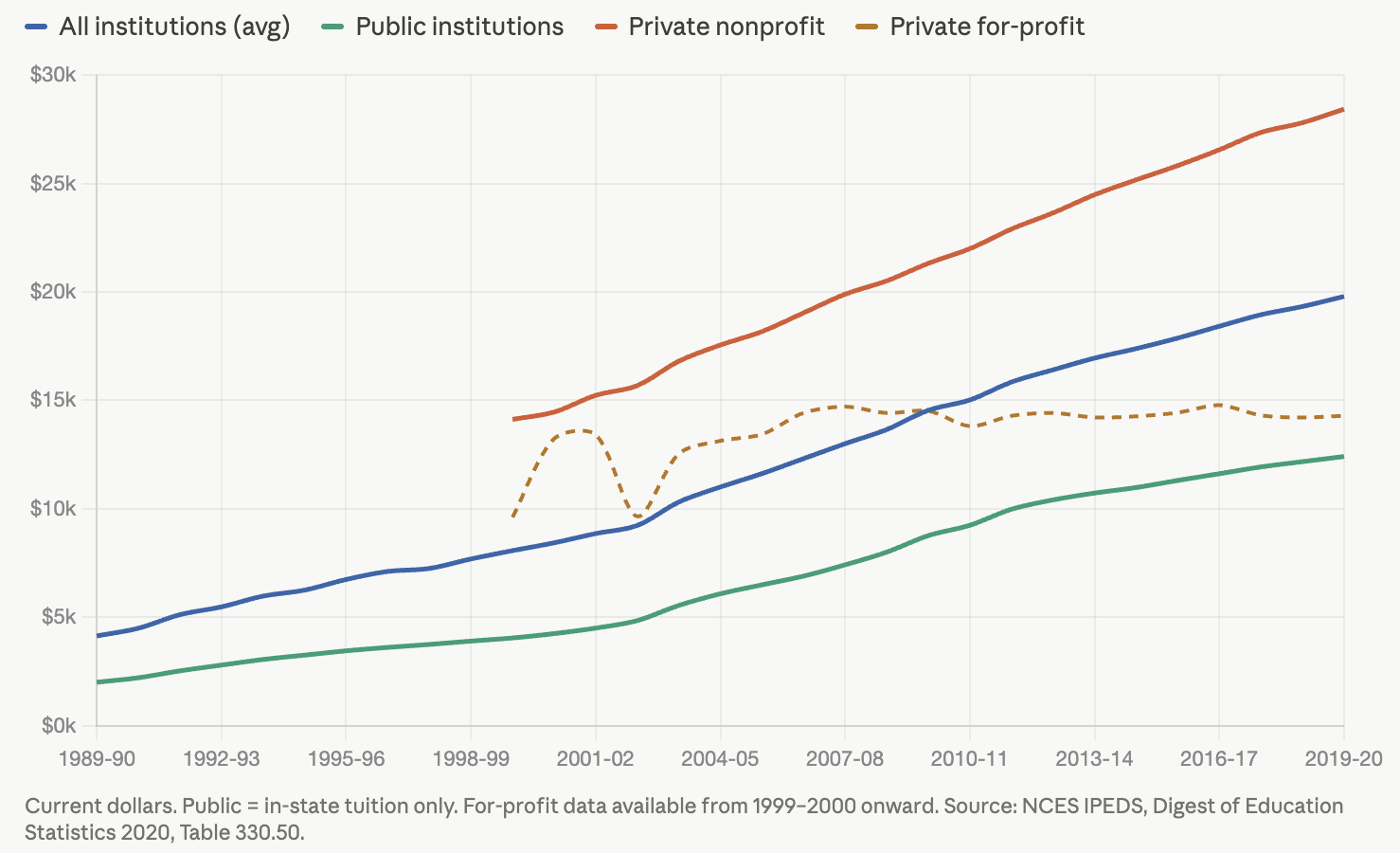
Graduate education costs have climbed in the last three decades. The average cost of graduate school increased nearly 180% between 1989 and 2022. Public institutions saw tuition rise from $4,440 to $12,600, representing a 184% increase. Private schools experienced more modest but still substantial growth, jumping from $17,505 to $28,020, an increase exceeding 60%.
Your MSW degree faces as much upward pressure. Tuition for social work programs has risen by over 15% in recent years. Most MSW programs implement annual increases between 2-5%, though institutions attempt to keep these adjustments minimal. Median annual tuition and fees for graduate programs surged from $3,000 to $10,000 between 2000 and 2020, a growth rate of 233%. Graduate degree costs for students tripled during this same period, while median debt principal for borrowers rose more than 47% to $50,000.
The total cost picture extends beyond posted tuition rates. The average total cost of a social work degree program ranges from $25,000 to $70,000 in 2026 when you factor in tuition, required fees, technology and living expenses. An MSW costs $20,000 to $50,000 for the complete program. Public in-state programs charge between $14,000 and $25,000 for a full two-year degree, well below the national average. Private graduate school costs remain steep at $26,621 each year, with some programs reaching $89,000.
Mandatory fees add unexpected expenses to your budget. The National Center for Education Statistics shows these required charges can add $400 to $1,200 per academic year. Council on Social Work Education data shows that 60% of accredited programs impose additional mandatory fees averaging around $800 each year. You should also plan for $1,200 to $1,500 each year for books and materials, plus $300 to $900 for technology and student services.
Recent years have brought a change in this growth pattern. Tuition increases slowed from 2010 to 2022, with annual growth rates falling from an average of 5.6% between 2005 and 2010 to just 2.0% from 2016 to 2022. Real net tuition growth rates dropped even more, from 3.0% to negative 0.6% during the same periods. Tuition and fees for in-state students decreased by 11% between the 2019-2020 and 2024-2025 academic years when accounting for inflation.
So, some institutions now offer cohort-based pricing that locks your rate when you enter the program. This model means your tuition remains constant throughout your enrollment as long as you progress as expected. While fees remain subject to annual changes based on Board of Regents approval, this structure provides cost predictability for planning your finances.
Public universities continue to provide quality education at substantially lower rates. Public institutions charge an average of $12,394 each year compared to private schools. Given these persistent cost pressures, finding affordable MSW programs online has become essential for managing your total investment while pursuing this career path.
How to Make Programs More Affordable
Several strategic moves can greatly reduce what you pay for your MSW degree. Start by submitting the Free Application for Federal Student Aid (FAFSA) well before deadlines. Schools set March 1 as the cutoff for fall admission and October 1 for spring applicants to ensure full consideration for available funds. Graduate students may qualify for up to $20,500 per year in unsubsidized federal loans, plus federal work-study opportunities. Filing the FAFSA unlocks need-based grants or scholarships from your state or university and serves as your gateway to multiple funding sources.
Loan forgiveness programs eliminate significant debt if you work in qualifying settings after graduation. The National Health Service Corps offers between $25,000 and $100,000 in loan repayment for licensed clinical social workers who commit to 2-3 years of service at eligible sites. State programs provide comparable relief. Minnesota offers $20,000 per year for a two-year commitment. North Carolina provides up to $50,000 per year for three years of service in high-need rural communities. Michigan’s program stands out with up to $300,000 over ten years for clinical social workers serving in Health Professional Shortage Areas.
Employer sponsorship agreements create another pathway. About 92% of employers provide tuition assistance or reimbursement. Your employer may cover part or all of your tuition if you work in healthcare, social services, or education, especially when the degree fits with your role. Some organizations pay institutions directly rather than requiring you to front costs and wait for reimbursement. Formal sponsorship agreements fund your education in exchange for a commitment to remain with the organization or move into a designated role after graduation.
Accelerated and dual-degree programs cut both time and expenses. Accelerated options let you fast-track through studies and reduce tuition, housing, and transportation costs. Dual-degree programs combine multiple credentials, such as a BSW and MSW. This results in fewer required credits, shorter timelines, and lower overall costs. Income-driven repayment plans keep monthly payments manageable while you work toward loan forgiveness. These plans calculate payments based on your income rather than your total debt and make affordable MSW programs online even more available through strategic payment structuring.
Interest-free payment plans at institutions like Rutgers allow you to spread costs across each semester without accruing additional charges. This provides breathing room in your budget while you complete your program.
Find Your Affordable MSW Today
Picking an affordable MSW program needs you to think over many factors beyond tuition costs. These 17 programs show that quality education stays available, with tuition between $280 and $1,037 per credit hour. Each school has its own special focus – from rural social work at University of Wyoming to environmental justice at University of Montana.
Your perfect program should line up with what you can afford and where you want your career to go. Texas State and Angelo State give Texas residents great value, while Western New Mexico University has good rates whatever your residency status is. Field education needs vary substantially, from 400 to 1,080 hours. This lets you pick programs that fit your schedule and help you grow professionally.
MSW graduates make about $13,000 more each year than BSW holders – that’s a solid return on your investment. Many schools are a great way to get financial help through assistantships, scholarships, and military discounts. This makes advanced education easier to reach.
Of course, getting an MSW takes dedication. But these budget-friendly programs show you can move up in your social work career without drowning in debt. You should ask multiple programs about their specialties, how they deliver courses, and total costs to find what works best for you.
**Note: We did our best to review tuition and fee information accurately, but we are human . Colleges change tuition quite often, so be sure to check with the school’s website and financial aid department for the most current information.